
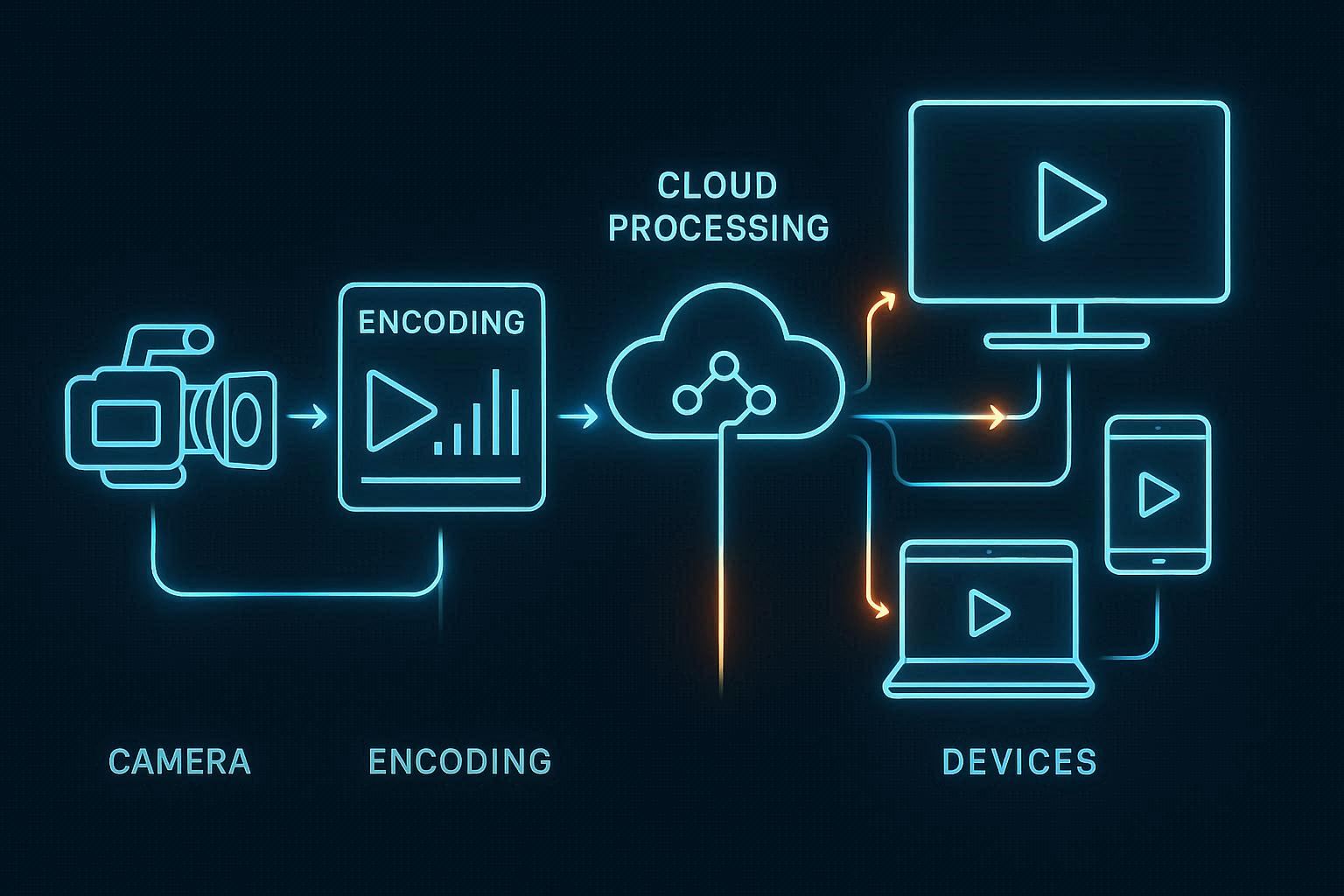
Ever wondered what happens after you click play?
Most viewers never think about it. Content appears magically on their screens. Buffering rarely interrupts anymore. Quality adjusts seamlessly to connection speeds.
This seamlessness isn’t magic. It’s engineering.
Understanding the technology behind streaming reveals why some platforms excel while others frustrate. This knowledge helps creators and businesses choose infrastructure wisely.
Let’s peek behind the curtain.
The Journey of a Live Broadcast
When broadcasters go live, a complex chain of events begins. Each step must work perfectly for viewers to see anything.
Capture and Encoding
Everything starts with cameras and microphones. They capture raw audio and video signals continuously.
These raw signals contain enormous data. Transmitting them directly would overwhelm any internet connection. Encoding compresses this data dramatically while preserving quality.
Modern encoders work incredibly fast. They process video frames in real-time, creating streams small enough for transmission.
Transmission to Servers
Encoded streams travel from broadcast locations to central servers. This journey must happen quickly and reliably.
A capable live streaming provider maintains infrastructure handling these incoming streams from countless simultaneous broadcasts. Redundancy ensures single failures don’t interrupt service.
Transcoding for Multiple Formats
Not all viewers have identical connections or devices. One stream format cannot serve everyone optimally.
Transcoding creates multiple versions of each stream. High-quality versions serve fast connections. Compressed versions reach viewers with limited bandwidth.
This multiplication happens in real-time for live content. Powerful servers process streams instantly.
Global Distribution
Viewers span continents. Serving everyone from central locations would create unacceptable delays.
Content delivery networks place copies of streams at edge locations worldwide. Viewers receive content from nearby servers, minimizing distance-related delays.
On-Demand Content Complexity
Recorded content seems simpler than live broadcasting. In some ways it is. But new complexities emerge.
Storage at Scale
Content libraries grow continuously. Every upload adds to storage requirements. Popular platforms hold millions of hours of video.
Storage must be reliable, accessible, and economically sustainable. Redundancy prevents content loss. Geographic distribution enables fast access.
Organization and Discovery
Massive libraries become useless without organization. Viewers can’t watch content they cannot find.
A robust video content management solution handles metadata, categorization, and searchability. Proper organization enables discovery and recommendation systems.
Adaptive Playback
Connection quality fluctuates during viewing. Initial quality assessment doesn’t guarantee continuous capability.
Adaptive bitrate streaming monitors playback conditions constantly. Quality adjusts dynamically as conditions change. Viewers experience smooth playback despite variable connections.
The Authentication Layer
Not all content is free or public. Access control adds another infrastructure layer.
Identity Verification
Subscribers need verified access. Anonymous viewers need appropriate restrictions. Systems must know who’s watching.
Authentication happens quickly and invisibly. Delays here frustrate viewers before content even begins.
Entitlement Checking
Verified identity isn’t enough. Systems must check what each viewer can access.
Subscription levels grant different access. Geographic restrictions apply to some content. Time-limited access expires appropriately.
Token Generation
Secure tokens grant temporary access to specific content. These tokens prevent unauthorized sharing of access links.
Token systems balance security with viewer convenience. Too much friction drives viewers away.
Analytics and Intelligence
Understanding viewership requires constant measurement. Analytics systems track everything happening across platforms.
Real-Time Monitoring
Live broadcasts need immediate feedback. Viewer counts, quality metrics, and engagement measures appear instantly.
Delayed information can’t help with live content. Problems must surface while solutions remain possible.
Historical Analysis
Patterns emerge over time. Which content performs best? When do viewers watch? Where do they abandon content?
Historical data informs content strategy. Understanding past performance guides future decisions.
Predictive Capabilities
Advanced analytics predict future behavior. Traffic forecasting prevents capacity surprises. Content performance predictions guide investment.
Security Throughout
Content protection requires attention at every layer. Vulnerabilities anywhere enable exploitation.
Encryption in Transit
Content traveling between systems needs protection. Encryption prevents interception and copying.
HTTPS and DRM systems protect content throughout its journey from source to viewer.
Encryption at Rest
Stored content also needs protection. Server breaches shouldn’t expose raw video files.
Encrypted storage adds security layers protecting archived content.
Forensic Capabilities
When content leaks occur, identification helps response. Watermarking enables tracing unauthorized copies.
Invisible markers identify which viewer accounts accessed leaked content.
Infrastructure Reliability
All these systems must work continuously. Downtime directly impacts viewer experience and business revenue.
Redundancy Everywhere
Critical systems have backups. Server failures trigger automatic failover. Network problems route around obstacles.
Thoughtful redundancy prevents single points of failure from causing outages.
Geographic Distribution
Regional problems shouldn’t affect global audiences. Distributed infrastructure contains failures geographically.
Continuous Monitoring
Problems must surface before viewers notice. Monitoring systems watch everything constantly.
Automated alerts trigger immediate response. Many issues resolve before impacting viewers.
The Integration Challenge
These systems must work together seamlessly. Integration failures create viewer-facing problems.
API Connectivity
Systems communicate through APIs. These interfaces must be reliable, fast, and well-designed.
Poor integration creates bottlenecks and failure points. Quality integration enables smooth operations.
Data Consistency
Information must stay synchronized across systems. Viewer entitlements, content metadata, and usage data need consistency.
Inconsistency creates confusing viewer experiences. Data integrity matters throughout.
Looking Toward 2026
Infrastructure continues evolving. New technologies enable better experiences.
Edge computing moves processing closer to viewers. AI improves encoding efficiency. 5G enables mobile quality improvements.
The invisible machinery behind streaming grows more sophisticated annually.
Your favorite streaming experiences depend on this hidden complexity. Understanding it helps appreciate the engineering enabling modern content delivery.
Next time you click play, you’ll know what happens behind the scenes.