
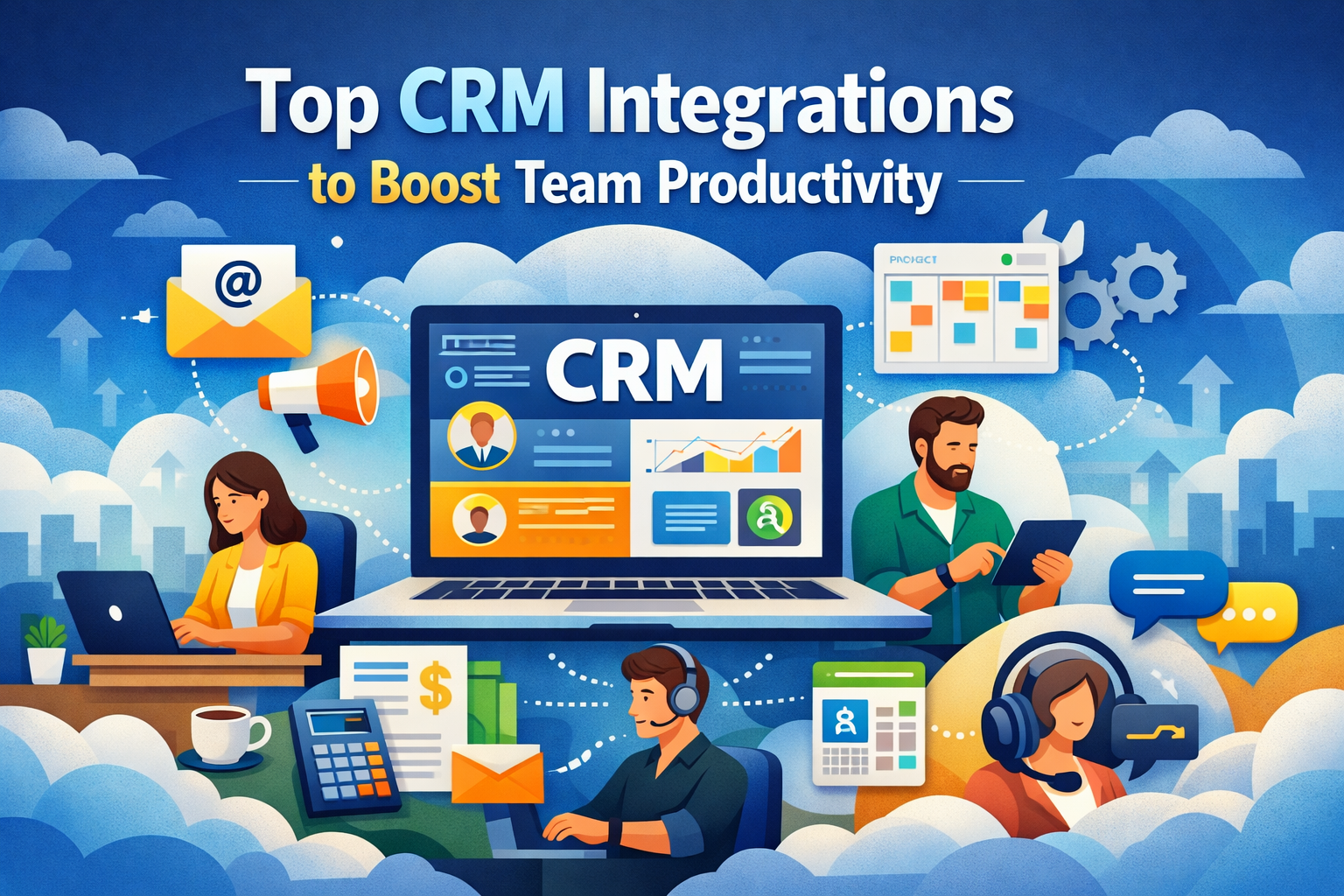
Today’s businesses are using CRM systems more than ever before to help them deal with a fast-paced digital workplace. The information that is stored in a CRM system can be leveraged to enhance customer communication, manage internal processes, and help employees work more efficiently together.
The modern CRM system is now also viewed as a very powerful tool when integrated with other commonly used business applications or systems. For example, companies like Outright Systems have developed ways to help organizations achieve the greatest benefit from their CRM systems by integrating them into their daily business operations with complementary technologies.
Integrating a CRM with other systems will reduce the amount of time spent doing repetitive manual tasks, remove the challenge of dealing with multiple independent sets of data, and allow team members to work together more effectively. An example would be an integrated CRM and how it would communicate with email service providers, marketing tools, accounting systems, or project management software.
If a software application allows a team member to see what the email attachment, the marketing automation tool, the accounting system, and the project management system all look like within a single application, then they are spending less time switching between applications and more time completing important work.
In this article, we will share the most popular CRM integrations that have been proven to significantly increase the productivity of teamwork and give your insight as to how they function and why they are so important.
What Are CRM Integrations?
Connecting a company’s CRM (Customer Relationship Management) software with other applications that are now in place inside their organization creates CRM integrations.
This means that once an individual fills out a lead application form on a website, depending on how the integration has been set up, a company can automatically insert that lead into their CRM database as well as send a notification email/message to their sales force.
The main objective of a company’s CRM integration is to develop a seamless workflow. By taking advantage of integrated systems, organizations can synchronize data across all the systems used by an organization rather than repeatedly entering the same information into several different locations.
Thus, organizations save time, limit the number of errors made by entering the same data repeatedly, and allow everyone within the company to obtain accurate and up-to-date data.
Why CRM Integrations Are Essential for Productivity
Disconnected toolsets can create productivity roadblocks for teams. For example, sales professionals who can’t access marketing data, or support department employees who find themselves in the dark about a customer’s purchase history, face challenges daily.
Integrating your customer relationship management (CRM) system with the majority of tools you already use is one of the ways to address these types of issues.
When you have an integrated solution that allows for automation of repetitive tasks, improved collaboration between departments, and rapid, data-driven decision-making, you can create more successful teams as they grow.
As your team continues to expand, and as productivity in a high volume of work will likely lead to increased complexity, integrated CRM systems become even more necessary for future success.
CRM and Email Integration
How It Works
Email integration provides the ability to link your CRM to any email service(s) you may be using, such as Gmail, Outlook, etc. With email integration, all the emails, conversations and follow-ups you have had with customers will automatically be recorded in your CRM.
Productivity Benefits
Your sales representatives will no longer need to manually search their personal inboxes to find any emails related to a customer; every email will be stored directly within the CRM so that the entire email history for each customer is available. Furthermore, there will be automated reminders and follow-ups for every lead and customer, so that nothing is missed.
Email integration improves collaboration among your team, because before a member of the team calls or contacts a customer, they will be able to view all of the previous email correspondence with that customer.
CRM and Marketing Automation Integration
How It Works
Marketing automation tools help you create, manage, and measure the effectiveness of marketing campaigns through your CRM system. All of the data collected by the various tools (opens, clicks, form submissions) flow directly into your CRM.
Productivity Benefits
If you are still planning your CRM strategy and developing your CRM processes, you should consider connecting with a partner who can provide you with customized solutions, such as through Banza development, so that your integrations are built specifically around your business processes.
CRM and Project Management Integration
How It Works
Software that manages tasks and projects such as Jira, Asana, or Trello can be linked to a company’s either sale or customer relationship management (CRM) systems. When this occurs, all information associated with customers will be available in a project management system.
Productivity Benefits
The automation of project creation based on a deal closing will enable businesses to define specific tasks for their employees, while also automatically creating due dates associated with the task creation. Employees across different departments will be able to monitor the progress of projects without having to manually transfer information between systems.
When everyone knows who they are accountable for, it allows for greater accountability and transparency within organizations. In addition, it allows customer service staff to have access to real-time updates on the status of ongoing projects and communicate effectively with their clients.
CRM and Customer Support Integration
How It Works
By linking customer service platforms to CRM systems, companies can consolidate all customer support activities (including tickets, chat logs and call history) in one place.
Productivity Benefits
Customers support agents will have the ability to view customer profiles, purchase history and, previous interactions with you instantly, enabling them to resolve customers’ issues quicker and provide them with personalized assistance.
The ability to automate escalations and follow-up processes will decrease the length of time it takes to respond to a customer’s inquiry, subsequently increasing the customer’s level of satisfaction.
Eliminating the need to switch backs and forth between systems or programs will allow your support teams to work more efficiently handling multiple tickets.
CRM and Accounting Integration
How It Works
Integrating your accounting software with your CRM will give you access to all your customers’ financial data, including but not limited to invoices, payments, and billing details.
Productivity Benefits
Because your finance and sales teams have access to the same financial data, there will be significantly less chance of miscommunication and confusion between departments. Upon completion of a deal, you will be able to automate the invoice process (generate an invoice) and automatically update CRM with payment status.
Minimization of manual data entry, maintenance of accurate financial records, and enhancement of cash flow are some of the benefits of the above-mentioned integration for a business.
CRM and Communication Tools Integration
How It Works
Integrating Communication solutions (such as Slack and Microsoft Teams) with CRM systems to provide notifications and updates.
Productivity Benefits
The Instant Alert feature notifies the appropriate staff members when they have received a New Lead, or Update to a Deal, or Activity on an Account. Therefore, all staff members will have access to real-time information regarding their customers and the business at large, allowing for greater collaboration and enhanced responsiveness. With these integrations, your team will not have to continuously access the CRM dashboard to keep up to date.
How to Choose the Right CRM Integrations
Determining what CRM integrations to implement is directly related to the business objectives and the workflows of the business. First, identify the repetitive and time-intensive tasks that are currently being performed. You will want to identify those Integrations that will eliminate the manual tasks currently performed and produce more accurate data.
Additionally, the scalability of the tools you choose is important because they will need to be compatible with your future development and their ability to grow with your organization. When selecting products, you should consider things like their ease of integration with other systems, how well they are supported by the provider, and how secure they will be in your environment.
Best Practices for Implementing CRM Integrations
To effectively integrate CRM tools into your organization, it’s important to develop a clear plan that describes what your integration strategy will be and the rationale behind it. In addition to your IT staff, ensure that members from other departments in your organization are actively involved in determining the systems you will use and how the new implementations will affect their workflows.
Prior to implementing any CRM solution, you should test the software thoroughly. Following implementation, you will need to continue monitoring the software and use the collected feedback to improve it. In addition, it is important to regularly review how these products are functioning within your organization to ensure that as your organization continues to grow and change, the products continue to provide value to you.
The Long-Term Impact of CRM Integrations
CRM software integration ultimately changes how teams in your organization operate. With integrated CRM software, teams work within an interconnected system where information flows easily and processes run efficiently. As a result, increased efficiency between teams leads to improved co-operation and decision making based on data.
Companies that use the proper CRM integration will give themselves a competitive edge and be able to respond faster to customers as well as quickly adapt to changing market conditions.
Conclusion
CRM integration helps enhance team productivity by allowing you to connect your critical business tools and systems together into one complete platform for managing and tracking all aspects of your business, from email and marketing to project management and accounting.
By connecting these tools and systems, organizations eliminate communication barriers between employees, enhance employee performance, and improve organizational efficiency.
The value of a CRM can be fully realized when organizations establish the right types of integrations and utilize the best integration practices to empower their teams to excel.
As more organizations continue to adopt digital transformation, adopting smart and efficient integrations and implementing intelligent automation systems will be critical for ensuring long-term productivity and growth.