
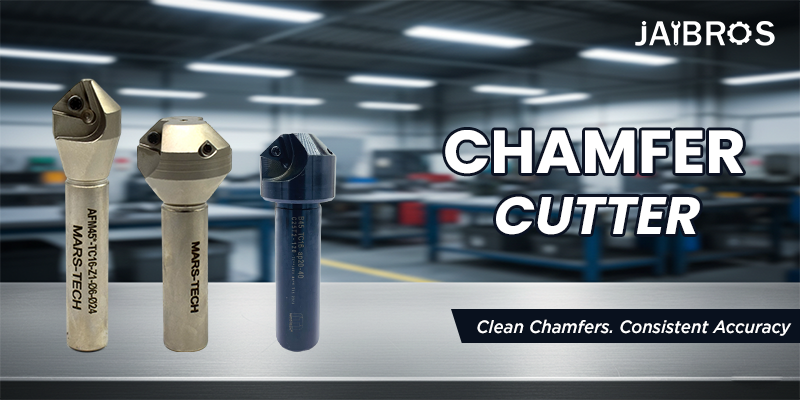
The Importance of Chamfer Tools in Precision Machining
Precision machining is all about achieving accuracy, safety, and consistency in every manufactured component. Even the smallest edge detail can influence how a part fits, functions, and lasts in real-world applications. One often-overlooked but critical aspect of this process is edge finishing. This is where a chamfer tool plays a vital role in ensuring high-quality machining results.
Chamfering is not just about appearance—it directly impacts part performance, assembly ease, and operator safety. In modern CNC machining environments, chamfering has become a standard operation rather than an optional finishing step.
Understanding Chamfering in Machining
Chamfering refers to the process of creating a beveled edge between two surfaces, usually at a specific angle. This beveled edge removes sharp corners that are left behind after drilling, milling, or turning operations.
In precision machining, sharp edges can cause multiple problems, including difficulty during assembly, stress concentration, and increased wear. A chamfer tool is specifically designed to create uniform and controlled bevels, ensuring that parts meet functional and dimensional requirements.
Improving Part Assembly and Fitment
One of the main reasons chamfering is essential is improved assembly. Sharp edges can interfere with proper alignment, especially in press-fit or mating components. Chamfered edges guide parts into position smoothly, reducing the risk of damage during assembly.
In high-precision industries such as automotive and aerospace, even slight misalignment can result in performance issues. By using chamfering operations, manufacturers ensure consistent part fitment and reduced rejection rates.
Enhancing Safety for Operators and End Users
Sharp edges pose a safety hazard on the shop floor and in final applications. Machinists handling unfinished components are at risk of cuts and injuries if edges are not properly finished.
Chamfering eliminates these sharp corners, making parts safer to handle during production, inspection, and installation. For end users, chamfered edges reduce the risk of injury and improve overall product usability, especially in consumer-facing components.
Reducing Stress Concentration and Improving Durability
Sharp internal or external corners act as stress concentrators, which can lead to cracks or premature failure under load. Chamfered edges distribute stress more evenly across a component’s surface.
This stress reduction is particularly important in parts subjected to vibration, pressure, or cyclic loads. By incorporating chamfering into the machining process, manufacturers enhance the durability and service life of components without altering their core design.
Achieving Better Surface Finish and Quality
Precision machining is not only about tight tolerances but also about surface quality. Clean, uniform edges contribute to a professional finish and improve the overall appearance of the part.
Using a chamfer tool ensures consistent chamfer size and angle across multiple components. This consistency is critical in batch production, where visual uniformity and dimensional accuracy are closely monitored.
Supporting CNC Automation and Repeatability
Modern CNC machines rely heavily on automation and repeatability. Manual edge finishing introduces variability, increases labor costs, and slows down production.
Chamfering operations performed within the CNC cycle allow manufacturers to maintain tight process control. With the correct programming, chamfers can be applied consistently across thousands of parts, improving productivity and reducing manual intervention.
Importance of Chamfer Angles in Precision Machining
Chamfer angles are selected based on functional and design requirements. One commonly used option is the chamfer tool 45 degree configuration, which provides a balanced bevel suitable for most general applications.
The correct angle ensures optimal edge strength while maintaining ease of assembly. Selecting the appropriate chamfer angle is essential for achieving the desired performance without compromising part integrity.
Role of Back Chamfering in Complex Components
Certain machining applications involve internal edges or hard-to-reach areas where standard tools cannot operate effectively. In such cases, a back chamfer tool is used to machine edges on the reverse side of holes or internal features.
For CNC milling centers, especially vertical machining centers, a back chamfer tool for VMC allows machinists to complete internal chamfering operations in a single setup. This reduces repositioning, saves time, and improves accuracy.
Improving Efficiency and Reducing Rework
Parts with sharp or inconsistent edges often fail quality inspections, leading to rework or scrap. Chamfering helps eliminate these issues by producing clean and uniform edges from the start.
By integrating chamfering into the machining cycle, manufacturers reduce inspection failures and improve overall workflow efficiency. This proactive approach saves time, material, and operational costs in the long run.
Supporting Industry Standards and Specifications
Many engineering drawings and industry standards specify chamfer requirements for edges and holes. Ignoring these specifications can result in non-compliant parts.
Using a chamfer tool ensures that chamfer dimensions and angles meet design requirements consistently. This is especially important in industries where compliance and certification are mandatory.
Adaptability Across Materials and Applications
Chamfering is required across a wide range of materials, including steel, aluminum, cast iron, and engineering plastics. The right tooling approach allows machinists to achieve clean edges regardless of material hardness.
By selecting appropriate cutting parameters and tool geometry, chamfering operations can be optimised for both soft and hard materials without compromising tool life or part quality.
Why Chamfering Is a Must in Precision Machining
In precision machining, every detail matters. From safety and durability to assembly and aesthetics, chamfering contributes to overall product quality. A chamfer tool is not just a finishing accessory—it is a fundamental part of the machining process.
As manufacturing standards continue to rise, the importance of proper edge finishing becomes even more critical. Chamfering ensures that parts meet both functional and visual expectations in demanding applications.
Conclusion
Chamfering plays a crucial role in modern precision machining by improving safety, enhancing part performance, and supporting consistent production quality. From simplifying assembly to reducing stress concentration and meeting design specifications, chamfering adds value at every stage of manufacturing.
By understanding the importance of edge finishing and selecting the right tooling strategy, manufacturers can significantly improve machining outcomes. When used correctly, a tool helps achieve precision, reliability, and efficiency in CNC tool operations, making it an essential element in today’s machining environment.
FAQs
- Why is chamfering important in precision machining?
Chamfering removes sharp edges, improves assembly, reduces stress concentration, and enhances safety and part quality.
- What is the most commonly used chamfer angle?
A 45-degree chamfer is widely used because it provides a good balance between strength and ease of assembly.
- When is a back chamfer tool required?
Back chamfering is used for internal or reverse edges that cannot be reached with standard tools.
- Can chamfering be done automatically on CNC machines?
Yes, chamfering can be integrated into CNC programs for consistent and repeatable edge finishing.
- Does chamfering affect tool life or machining time?
When properly planned, chamfering adds minimal machining time and helps reduce rework, improving overall efficiency.