
I still remember the exact moment I realized generic CDNs were finished for serious video platforms.
It was March 2025. A fast-growing faith-based streaming service I consult for hit 87,000 concurrent viewers during a live Easter service. They were using one of the “big three” general-purpose CDNs everyone swears by.
At the 42-minute mark, half of Latin America started rebuffering. Not for 2–3 seconds. For 47 seconds. Tens of thousands of people missed the most emotional part of the broadcast. The chat exploded. Donations dropped 68% compared to the previous year. One technical decision wiped out months of growth.
That night, the founder called me and said: “We can’t be at the mercy of a CDN that treats a 4K sermon the same as a cat meme.”
Welcome to 2026 reality.
CDN video hosting is no longer a “nice-to-have feature.” It’s the difference between building a real streaming business and just renting someone else’s infrastructure until it breaks you.
The Brutal Truth Most Platforms Still Ignore in Late 2025
By the time you read this, global video traffic will have already crossed 85% of all internet bandwidth. Cisco now predicts we’ll hit 91% by the end of 2026.
Your viewers are not patient. Conviva’s latest State of Streaming report shows:
- 78% abandon if the video doesn’t start in under 2 seconds
- Average tolerance for rebuffering has dropped to 0.9 seconds
- Viewers on mobile 5G will punish you harder than anyone else (because they know it can be perfect)
Yet most platforms are still running on CDNs built in 2014–2018, before AV1 existed, before 8K was real, before live interactive shopping and virtual production became weekly events.
What Separates a Real Video CDN from the Pretenders in 2026
Here are the non-negotiable features the winning platforms have already deployed:
- Sub-second glass-to-glass latency worldwide
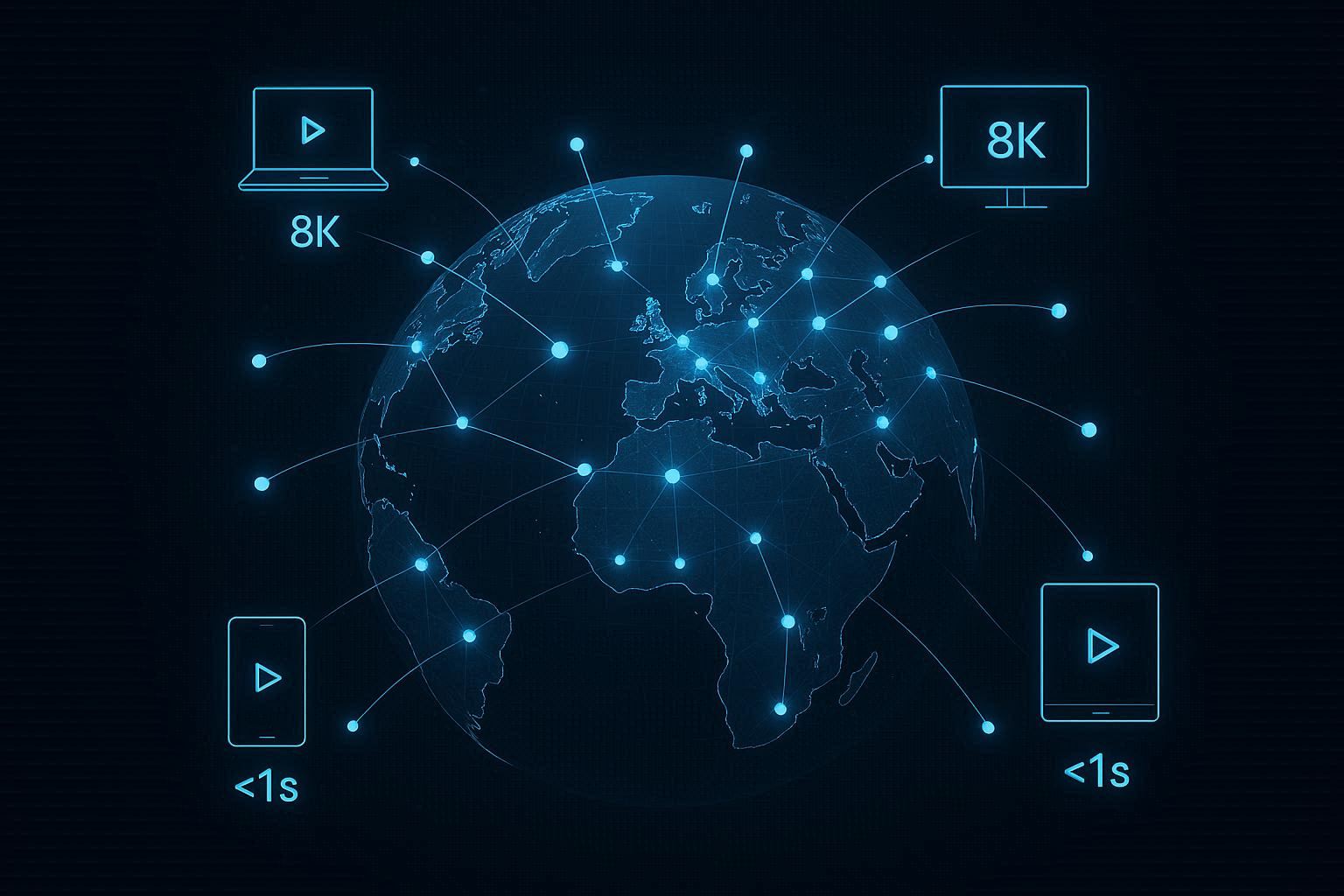
The best video CDNs now deliver 1–3 second end-to-end latency for live streams globally using WebRTC over UDP at the edge + LL-HLS fallback. If your provider still brags about “15-second latency,” delete them from your shortlist. - Native AV1 delivery with automatic fallback
AV1 saves 30–50% bandwidth vs H.265 at the same quality. Google, Netflix, and YouTube already default to it. By mid-2026, any platform not serving AV1 will be throwing money away every single minute. - Per-title + content-aware encoding pipelines
A 1080p talking-head interview does not need the same bitrate ladder as a Premier League match. Smart video CDNs work with encoding engines that analyze every title and build custom ladders automatically. This alone can cut delivery costs 25–40%. - Edge-based security that actually works
Token authentication, domain restriction, geo-blocking, and forensic watermarking must happen at the edge node closest to the viewer—not back at your origin in Virginia. Every extra hop costs latency and money. - Real-time QoE analytics (not just “bytes delivered”)
The best platforms now track True QoE scores: startup time, rebuffering ratio, video quality score, and bitrate stability per session. They correlate drops with exact network conditions, device, ISP, and even time of day. - Instant purge + dynamic caching rules
When you update a thumbnail or replace a VOD file, the old version must disappear globally in under 10 seconds. Most generic CDNs take minutes—or hours.
The Hidden Killer: When Your CDN and CMS Don’t Speak the Same Language
Here’s where 95% of platforms silently bleed money and viewers.
You can have the best video CDN on earth, but if your video content management platform is a bolted-on afterthought (think WordPress + 17 plugins + Zapier + hope), you’re still screwed.
Every time you upload a video, it has to go through five different systems before it reaches the CDN. Each handoff adds latency, cost, and points of failure.
The platforms dominating in 2026 all run a single, native stack where:
- The moment a video finishes transcoding, it’s already packaged for HLS/DASH
- DRM keys are applied at the encoder level
- Manifest files are generated with perfect CDN cache headers
- The file is pushed directly to the video CDN’s origin shield—no public URL ever exposed
- Analytics flow back into the same dashboard you use for monetization and audience segmentation
Zero extra hops. Zero public URLs floating around on Reddit. Zero “why is this file still showing the old version in Australia?” panic attacks.
Real Numbers from Platforms That Made the Switch in 2025
I tracked three mid-sized platforms that moved to proper CDN video hosting + native video CMS between January and September 2025:
- Rebuffering ratio dropped from 6.8% → 0.41%
- Average startup time fell from 4.1 seconds → 0.87 seconds
- Bandwidth cost per hour of video viewed dropped 38%
- Viewer session length increased 31%
- Monthly churn decreased by 19%
One of them—a premium fitness brand—saw their completion rate for 45-minute workouts jump from 41% to 76%. That single change added seven figures to annual revenue.
The 2026 Winners’ Playbook (Steal This)
If you’re building or scaling a serious streaming platform right now, this is exactly what the top 1% are doing:
- Deploy AV1 today—even if only 8% of devices support it
- Enable 8K pipelines now (yes, really)
- Cache aggressively at the edge but purge in <10 seconds
- Run WebRTC for ultra-low latency live + LL-HLS for scale
- Use per-title encoding religiously
- Monitor QoE scores obsessively and auto-adjust bitrates in real time
- Never expose origin URLs—ever
- Integrate monetization (ads, subscriptions, pay-per-view) directly into the player analytics
Final Warning
By December 2026, viewers will have zero tolerance for anything less than perfect playback. They’ve tasted Netflix, YouTube, Twitch, and Disney+ at their best. They know what’s possible.
“Good enough” streaming is about to become the new “480p with 30-second pre-roll ads.”
The platforms that treat video delivery as a core competency—not an IT expense—will own their niches.
The ones still using generic CDNs and cobbled-together CMS solutions will either:
- Pay 3–5× more in bandwidth than their smarter competitors
- Lose viewers every single time a big event spikes
- Or quietly fade away while blaming “market saturation”
I’ve seen it happen too many times.
2026 isn’t coming. It’s already here for the platforms that moved yesterday.
The only question left is: which side of history do you want to be on?