
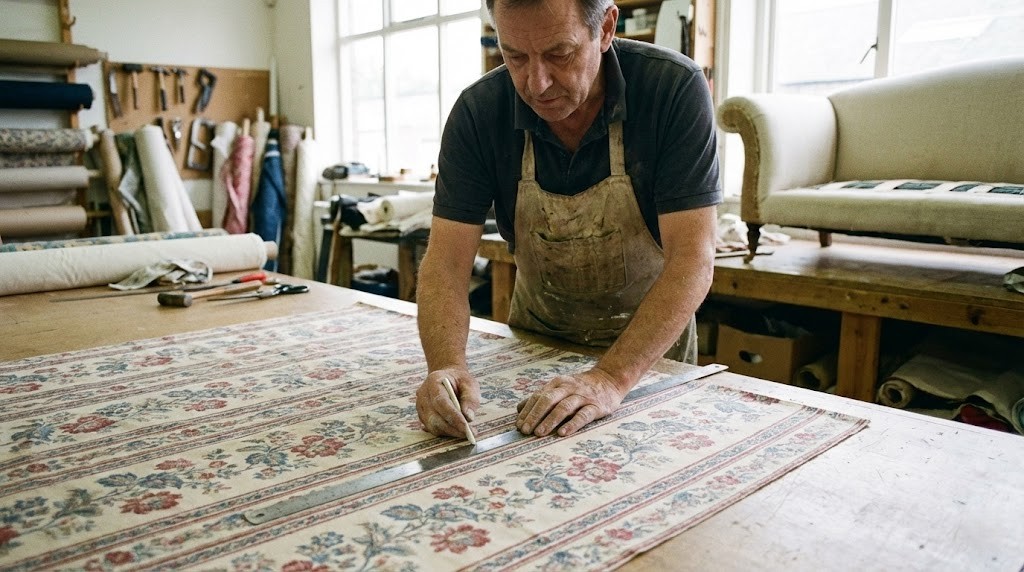
When you request a quote for reupholstering your sofa with patterned fabric, the higher price might catch your attention. It’s natural to wonder if you’re paying extra just for the look. However, the reality is more complex.
Pattern matching is a meticulous process that requires time, material, and expertise. When done correctly, it goes unnoticed. When done poorly, it’s the first thing you see. This is why experienced upholsterers charge more for this service, and why that additional cost is often justified.
Understanding Pattern Matching
Pattern matching involves aligning a fabric’s design across seams so that it appears continuous. Stripes line up seamlessly, florals flow effortlessly, and checks remain consistent at the joints. On a sofa, this means the pattern must stay consistent across cushions, arms, backs, and borders.
This process is more complex than it seems. Sofas have curves, panels of varying sizes, and seams that meet at angles. Fabric stretches and relaxes as it is pulled into place, making the alignment of patterns a challenging task. It’s not just about cutting pieces to the same size; it’s about planning how each cut will fit once the fabric is shaped over the padding and frame.
The Simplicity of Solid Fabrics
Solid fabrics offer a level of forgiveness that patterned fabrics do not. Small variations in seams go unnoticed with solid fabrics. However, with patterned fabrics, the eye is drawn to alignment. A stripe that is off by half a centimeter or a floral pattern that breaks at a seam can look messy.
This sensitivity is why patterned work requires more care. The upholsterer must anticipate where the center of the pattern will fall, where seams will break it, and which parts are most visible when someone enters the room. These decisions require experience and time.
The Cost of Fabric Waste
Pattern matching inevitably uses more fabric. To align a pattern, sections of cloth are often skipped to ensure the design lines up correctly on the next panel. This unused fabric is not a result of poor planning; it is the cost of achieving perfect alignment.
Stripes and plaids are particularly demanding, as are large-scale florals and geometrics. Even subtle repeats can add up across a full sofa. This is why quotes for sofa reupholstery services often include a higher fabric allowance when patterns are involved. If a quote seems high, asking how much fabric is needed and why can provide clarity.
The Deliberate Process of Cutting
Cutting patterned fabric is a slow and careful process. Each panel must be laid out with the design in mind. The upholsterer checks repeat measurements, aligns reference points, and marks cuts meticulously. Rushing this step can lead to problems that are difficult to fix later.
This step alone adds labor hours and showcases the skill of the upholsterer. Understanding how a pattern will behave once stretched over foam is not intuitive; it comes from extensive experience.
The Time-Consuming Nature of Sewing and Fitting
Once the pieces are cut, they still need to be sewn and fitted. Seams must meet precisely, and piping must carry the pattern cleanly around curves. Cushions must match each other when placed side by side.
Fitting often involves adjustments. A panel might need to be unpicked and resewn to correct alignment. This is a normal part of the process and is time-consuming. You’re paying for the patience and skill required to get it right.
The Challenge of Cushions
Loose cushions add another layer of complexity. Each cushion needs to match its neighbor and the frame behind it. Zippers, boxing, and welting can all interrupt the pattern if not planned well.
A common shortcut is to ignore cushion alignment and focus only on the frame. While this saves time, it results in an unfinished look. Skilled sofa reupholstery treats cushions as an integral part of the design, not an afterthought.
The Difficulty of Curves and Corners
Flat panels are forgiving, but curves are not. Arms, rolled edges, and corners distort fabric, causing patterns to bend and compress as the cloth wraps around padding. Keeping the design readable in these areas requires careful placement and controlled tension.
This is where experience is crucial. A seasoned upholsterer knows how to manage these challenges and when to adjust expectations. Sometimes, the best approach is to center the pattern on the most visible area and let it fade elsewhere. This is not cutting corners; it’s prioritizing what the eye sees.
The Variation in Quotes
If you’ve received different quotes for the same patterned job, it’s often because of how pattern matching is handled. One shop might include full matching across all panels, while another might only align the main faces, and a third might not match at all.
None of these approaches are inherently wrong. What matters is clarity. Ask what level of matching is included and request to see examples of similar work. A higher price usually reflects more thorough alignment and more fabric used.
When Pattern Matching is Worth the Investment
Pattern matching is worth the cost when the fabric has a strong visual rhythm and the sofa is a focal point. Living room pieces, statement sofas, and heirloom frames benefit most from this attention to detail. The cleaner the lines, the more noticeable the difference.
It may not be worth it for casual spaces or subtle patterns with short repeats. In these cases, partial matching can still look good without the full expense. A good upholsterer will discuss these options with you and explain where matching matters and where it doesn’t. This conversation should happen before any fabric is ordered.
Common Misconceptions
One common misconception is that pattern matching is solely about aesthetics. It’s also about proportion. Proper alignment helps a sofa look balanced and intentional. Poor alignment can make even expensive fabric look cheap.
Another misconception is that machines handle the work. They don’t. Upholstery is a hands-on process that requires judgment and adjustment at every step. That’s what you’re paying for.
Making an Informed Decision
If you’re considering patterned fabric, ask to see finished examples. Not just swatches, but completed pieces. Look at seams, check cushions, and observe how the pattern reads from across the room.
Ask how much extra fabric is needed and why. Inquire where the pattern will be centered. These are practical questions that a professional providing sofa reupholstery services should be happy to answer.
The Bottom Line
Pattern matching costs more because it requires more fabric, more time, and more skill. It’s not an add-on; it’s a different level of work. When done well, it disappears, and the sofa looks calm and cohesive. When done poorly, it distracts and disappoints. If you choose patterned fabric for reupholstery, the extra cost isn’t about luxury; it’s about doing the job properly. In the end, you’re not paying for a pattern; you’re paying for the discipline to respect it.