
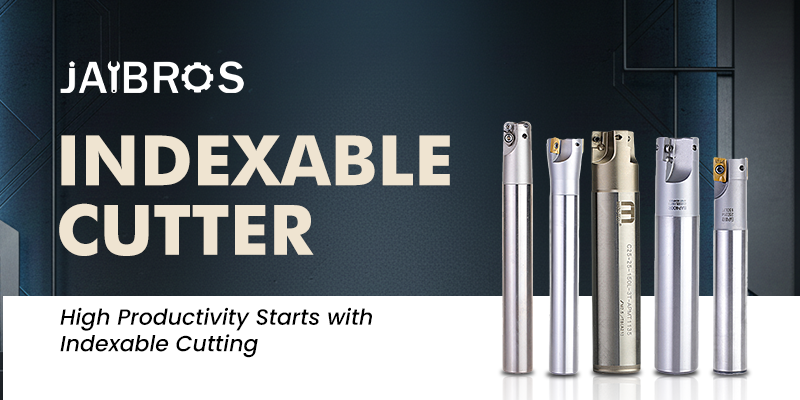
Discover how indexable tools help manufacturers cut tooling costs, reduce downtime, and improve efficiency in mass production with consistent machining performance.
How Indexable Tools Help Reduce Tooling Costs in Mass Production
High-speed production lines require the integration of rapid manufacturing time-based with stability and rigorous cost-effectiveness. Manufacturers face constant external pressures to reduce operational costs; however, these reductions can only be achieved within the limits of part quality and machining accuracy. By incorporating indexable tooling technologies into their modern machining processes, manufacturers can effectively meet this critical need. Indexable tools provide the opportunity for a dramatic transformation in the operation of high-volume production systems, enabling greater flexibility, improved efficiency, and ultimately, sustainable cost savings over time.
Understanding Indexable Tool Technology
Indexable machining technology uses replaceable cutting inserts mounted on a reusable tool body. Instead of replacing the entire cutter when an edge wears out, operators simply rotate or replace the insert. This design enables manufacturers to maintain cutting performance while significantly reducing tooling costs.
In mass production, where machines often run continuously, downtime and tool replacement costs can quickly add up. By switching to indexable tools, manufacturers gain greater control over tooling budgets and ensure consistent machining results across large batches.
Reduced Tool Replacement Costs
Indexable systems reduce overall tooling costs by enabling the reuse of components across your machinery. When the tool is worn or damaged, all solids must be replaced; with indexable systems, you only need to replace the insert(s) as they wear or are damaged. Hence, you can generate immediate savings on the purchase of tooling by having “replacement” parts as opposed to having to purchase complete tooling.
A good example of this is an indexable milling cutter that can be continuously saved through the repeated purchase/reuse of inserts. The savings from having inserts to reuse will far outweigh the cost of replacing complete tools when the tooling becomes worn or damaged. Possible areas that will benefit from this direction are found in the automotive, aerospace, and heavy engineering industries.
Lower Downtime and Higher Productivity
Machine downtime directly impacts profitability in mass production. Frequent tool changes interrupt production flow and reduce machine utilisation. With indexable cutting tools, insert changes are quick and simple, often requiring minimal machine stoppage.
This efficiency allows operators to return machines to production faster, increasing overall output. When production lines run smoothly with fewer interruptions, manufacturers can meet tight delivery schedules while keeping labour and operational costs under control.
Consistent Performance Across Large Batches
Consistency is critical in mass production. Variations in tool performance can lead to quality issues, rework, and material waste. Indexable tools are designed to deliver predictable cutting performance, even during extended machining cycles.
Indexable inserts are manufactured to precise tolerances, ensuring uniform cutting edges. This consistency helps maintain tight dimensional accuracy and surface finish across thousands of components, reducing scrap rates and quality-related costs.
Flexibility for Multiple Applications
Modern manufacturing often involves machining a wide range of materials and component designs. Indexable systems offer exceptional flexibility, as different insert grades and geometries can be used on the same tool body.
An Indexable end mill cutter for instance, can be adapted for roughing or finishing operations simply by selecting the appropriate insert. This versatility reduces the need to invest in multiple specialised tools, further lowering overall tooling expenses.
Improved Tool Life Management
Tool life monitoring is easier with indexable systems. Since inserts have multiple cutting edges, operators can maximise usage by indexing each edge before replacement. This efficient use of inserts extends tool life and improves cost-per-part calculations.
By carefully managing insert usage, manufacturers using indexable tools can achieve better predictability in tooling costs. This level of control is especially valuable in mass production, where even small savings per component can result in significant financial benefits.
Optimised Cutting Performance
Indexable inserts are available in a wide range of materials and coatings, designed for specific cutting conditions. This allows manufacturers to optimise cutting speeds and feeds without compromising tool life.
Higher cutting efficiency means faster cycle times and lower energy consumption per part. Over long production runs, these improvements contribute to noticeable reductions in operational costs, reinforcing the value of indexable technology.
Cost Savings in the Long Term
While the initial investment in indexable systems may appear higher than traditional tools, the long-term savings are substantial. Reduced tool purchases, lower downtime, improved productivity, and consistent quality all contribute to a lower total cost of ownership.
By integrating indexable tools into mass-production strategies, manufacturers can achieve a more sustainable, cost-effective machining process that supports long-term growth.
Sustainability and Long-Term Cost Optimisation in High-Volume Manufacturing
By using insert based tooling systems, manufacturers can quickly reduce their costs and improve the long-term sustainability and operational efficiency associated with mass production. Manufacturers who deal with customers have had to develop methods of reducing waste while maximising the use of natural resources. Therefore, tooling manufacturers that develop reusable, longer-lasting tooling for tooling systems have become the most desirable type of manufacturer for customers. By replacing worn cutting inserts with worn tools, customers can significantly reduce raw material use and associated environmental impacts.
The environmental savings associated with the use of tooling systems, however, pale in comparison to the impact they will have on stabilising customers’ tooling budgets over the long term. As insert consumption is much more predictable than worn tools, it allows production planners to develop more accurate forecasts of the tooling expenses. These forecasts play an essential role in the contract manufacturing industry and the OEM supply chain. Therefore, the ability to reasonably predict tooling expenses enables manufacturers to reduce unplanned downtime caused by tooling expenditures and develop pricing plans that accommodate large-volume orders.
Additionally, modern insert designs are optimised for improved chip control and heat resistance, which helps protect machine spindles and fixtures from excessive wear. This indirect benefit lowers maintenance costs and extends machine life—an often-overlooked factor in total production cost calculations. Over time, these efficiencies reduce the total cost of ownership across the entire manufacturing setup.
FAQs
Q1. What makes indexable tooling cost-effective for mass production?
Indexable tooling reduces costs by allowing insert replacement instead of complete tool replacement, minimising downtime and improving tool utilisation.
Q2. Are indexable tools suitable for high-speed machining?
Yes, many indexable systems are designed for high-speed and high-feed machining, offering excellent performance and durability.
Q3. How do indexable inserts improve production consistency?
They are manufactured with precise tolerances, ensuring uniform cutting edges and consistent machining results across large batches.
Q4. Can indexable tools handle different materials?
Absolutely. Inserts are available in various grades and coatings, making them suitable for steel, cast iron, aluminium, and exotic alloys.
Q5. Do indexable systems require skilled operators?
Basic training is sufficient. Most indexable systems are designed for easy insert changes and straightforward tool management.
Conclusion
In today’s competitive manufacturing landscape, controlling tooling costs is essential for profitability. By adopting indexable tools, manufacturers can significantly reduce expenses while maintaining high productivity and consistent quality in mass production. Their flexibility, efficiency, and long-term cost benefits make them a wise investment for modern machining operations.
Jaibros is a trusted name in the CNC tooling industry, offering a wide range of high-quality machining solutions designed for precision and durability. With a strong focus on innovation and customer satisfaction, Jaibros helps manufacturers achieve reliable performance and cost efficiency across diverse production needs.