
The island of Sri Lanka is a place of convergence of ancient civilizations, religion, and colonialism to form a rich cultural textile. To tourists who are interested in history, architecture, and religious background, the island is full of stories that have been etched in stone and have been there since centuries. This article is an elaborate guide to Sri Lanka tourism to any individual who is keen on traveling to this nation to see temples, the remnants of the past, fortresses and ancient cities that bring out the soul of the country.
Anuradhapura: The Sacred Ancient Capital
Anuradhapura is also among the oldest continuously inhabited cities in the world that has served as a foundation of the Sri Lankan cultural identity. It was established more than 2,500 years ago and it became the center of Sinhalese civilization and Buddhism. Extremely large dagobas like Ruwanwelisaya and Jetavanaramaya demonstrate a high level of engineering of the past, and the sacred Sri Maha Bodhi tree, planted out of a sapling of what is now called the Bodhi Tree in India, is worshiped by millions of pilgrims. Anuradhapura is one of the most important Historical Places in Sri Lanka providing a closer insight into the early religious practices and royal customs.
The Medieval Marvell of Polonnaruwa
Polonnaruwa became the capital following the collapse of Anuradhapura and is very well preserved. Visiting this UNESCO World Heritage is like going into a royal past. The artistic perfection of the time is captured in the Gal Vihara rock temple through its peaceful Buddha images that have been carved out of one granite slab. The Polonnaruwa Kingdom can be described as a sophisticated kingdom as evidenced by royal palaces, audience halls, and ancient irrigation systems, and it is a place that must be visited by cultural explorers.
Sigiriya: the Lion Rock Castle
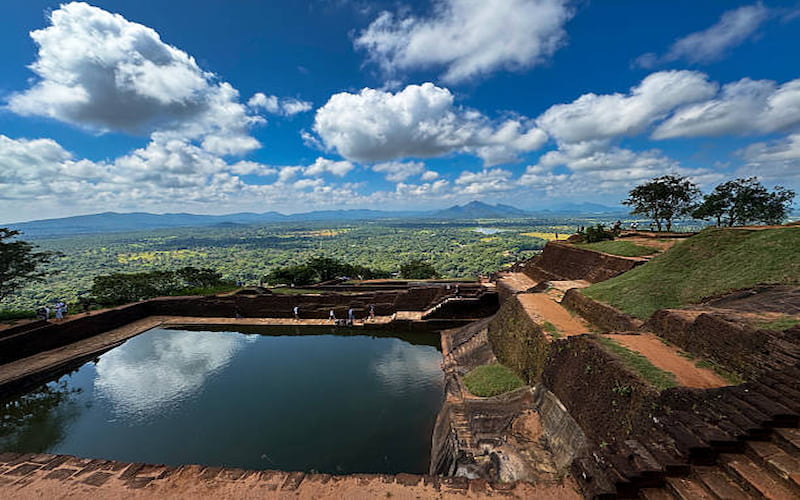
Sigiriya is a landmark and one of the most remarkable structures in Sri Lanka, which is a remarkable ancient form of urban planning. This giant rock castle rose up sharply amidst the nearby plains, and was constructed by King Kashyapa during the 5 th century. Tourists make their way up colorful frescoes, mirror walls and landscaped gardens to the top where the remains of a royal palace stand. Sigiriya is one of the most photographed Historical Places in Sri Lanka being one of the most well-known sites globally; the attraction is not only about beauty but also about history.
Dambulla Cave Temple: Stone Art
The Dambulla Cave Temple complex is yet another UNESCO-listed site and it is located near Sigiriya. It is made up of five caves, which are decorated with more than 150 statues of Buddha and bright paintings of the walls which are centuries old. The painting shows the development in artistic ways and religion over the years. Dambulla is a very current place of worship and provides travelers with both spiritual and cultural experience.
Kandy: The Last Royal Kingdom
The last capital of the Sri Lankan kings before the colonialists was Kandy, which was surrounded by foggy hills. It has the Temple of the Sacred Tooth Relic, the most sacred Buddhist object, and is most popular in the city. The Esala Perahera festival that takes place every year during the traditional dancers, drummers and decorated elephants are some of the features that reflect the living heritage of Kandy. What is great about this city is that a trace of history is still visible in the everyday life.
Galle Fort: Colonial Elegance
Relle Galle Fort in the south coast tells another tale about the history of the Sri Lanka. The construction of the fort by Portuguese, and subsequent expansion by Dutch, was a mix of European architecture and the native culture. There is a special atmosphere of cobblestone streets, old churches, ramparts, and houses, which appeared in the colonial era. The Galle Fort is a rich cultural centre today boasting museums, cafes and art galleries that have undergone centuries of international influence.
Yapahuwa and Pareto Treasures
It is not only the famous locations that make Sri Lanka full of unexplored historical sites. One of the former capitals, Yapahuwa, has a theatrical rock fortress, with intricate stairways and carvings made of the stone. Mihintale which is regarded as the origin of Buddhism in Sri Lanka has both scenic views and religious value. These destinations offer less but more valuable experiences to the travellers who want the authenticity.
Traveling as a way of preserving Heritage
Learning about Sri Lanka Historical Places does not solely mean sightseeing but also about the strength, religion and artistry of this island. Each location creates a part of a larger story that is thousands of years old. Responsible tourism has a crucial role in conservation of such treasures to the generations to come.
We are certain that cultural tours ought to be experiential and educative at Go Kite Tours. Our carefully worked itineraries can enable the tourists to explore the heritage of Sri Lanka with well-informed guides, convenient methods of traveling as well as valuable local experiences. You are going to the familiar landmark attractions or quietly discovering historical secrets, we will have you traveling with a purpose in mind.
Conclusion
The cultural and historical sites are the eternal experiences in Sri Lanka apprising the mind and spirit. Since ancient capital cities and sacred temples to colonial castles and fastening rock citadels, the island gives its guests an invitation to travel through the history at every step. By thoroughly planning and professional advice of Go Kite Tours, finding these marvels can also be perfectly in line with Sri Lanka affordable travel, and it proves that the lasting cultural research does not necessarily cost a lot.
- Uganda Exploration Guide for Smooth Travel
- How Do You Experience Uganda’s Culture and Nature in One Tour?