
Early Language and Math Skills in Montessori Classrooms
Language and math skills are quite important in the early childhood. The early childhood is the time when essential language and math skills are developed. One of the main characteristics of the Montessori classrooms is their child-centric approach which is believed to be highly effective in the development of the skills mentioned above. Unlike traditional early learning methods that are based on memorization and teacher-led instructions, the Montessori method involves learning through discovery, correction of one’s mistakes and doing practical work. Such an approach not only imparts the educational material, but it also helps to develop the child’s personality traits like confidence, curiosity and the inner desire for learning.
Most of the parents nowadays are concerned about the real understanding of the material rather than just learning it by heart. The above-stated issue has led the majority of early learning centers and some playschools in Velachery to implement Montessori methods. The freedom of movement, the availability of age-appropriate instructional materials, and the tailored learning program provide opportunities for children to acquire language and math skills in a natural and fun way.
- Language Foundations in Montessori Classrooms
Language growth in Montessori starts from the time when a child is not familiar with reading or writing. The main aim of the program is to surround the kids with a wide range of words and multisensory activities. Conversational skills that include expressive and receptive language are developed through various activities such as games, using picture cards, and phonetic exercises.
- Spoken Language Exercises
Children undertake very simple activities at the initial stage, which help them to listen and speak. Among the grown-up activities, storytelling, object-naming games, picture cards, conversation time, and phonetic awareness are considered as the major ones. They not only help children get familiar with the language but also enable them to learn its structure and rhythm. Phonics are taught implicitly, and children listen to the sounds of the words in order to learn by themselves rather than the teacher forcing it on them.
The sound games play a major role in that they get the children used to recognize the starting, middle and ending sounds of the words, which then becomes the basic rules of phonetic reading. The concepts learnt through these initial activities give the kids the ability to see the logic behind the language structure long before letters are introduced.
- Introduction to Writing Through Hands-On Materials
A very significant aspect of early education that is largely due to Montessori method is the gradual sequence in which writing skills are inculcated. Before going for the traditional tools like pencil and paper, kids are first given an opportunity to interact with some materials such as sandpaper letters, metal insets, movable alphabets, and tracing trays.
By the help of sandpaper letters children unite the different sounds to the letters while at the same time the get to strengthen their memory by the sense of touch. Metal insets help to develop the fine motor control, thus once children start to use pencils they will be able to write without any difficulty.
Such a multisensory way of learning ensures that writing will be the logical next step from what the child has already done in speech.
- Reading Is the Last to Come
In the Montessori method, it is a common practice for children to write a few short phonetic words on their own before they can read independently. This is due to the fact that a written work is an expression of the current knowledge of a child, whereas a reading task involves breaking down the symbols given by somebody else.
After children have mastered phonetic patterns, sight words, and language structures, they are then allowed to move on to reading books that are specially made for beginners. This builds up the self-assurance and helps the natural development of the love for reading.
2. Early Mathematics the Montessori Way
As with language, math in Montessori schools is first presented by means of tangible, hands-on materials and only later are the children introduced to the abstract concept. Thus, the problem of fear, confusion, and misconceptions around numbers is solved.
- Concrete Learning Through Physical Materials
Montessori math materials number rods, spindle boxes, golden bead materials, and bead chains are created for kids to be able to touch, count, and visually understand quantity.
For instance: Number rods help to see the length and the quantity.
Golden beads show units, tens, hundreds, and thousands.
Beads chains facilitate skip counting and multiplication patterns.
Children start to think of math as something real, to be felt, and even lovely.
- Understanding Place Value and Decimal System
By using Montessori materials, children can physically grasp units, tens, hundreds, and thousands instead of just hearing the abstract rule of place value. They craft numbers with beads, replace them, and do simple math by means of real things.
This base of clarity helps kids to comprehend addition, subtraction, multiplication, and division without the need for rote memorization.
- Gradual Progression to Abstract Thinking
The kids move to more abstract work using number boards, strip boards, and exercises on paper after they have grasped this first through the use of concrete materials. This ensures that their mathematical reasoning is strong, meaningful, and without mistakes.
- Integration of Language and Math in the Classroom
One of the most prominent features of Montessori learning is the inter-subject connections. The language of mathematics words like “more,” “less,” “equal,” “pairs,” “sequence,” and “pattern” is introduced during daily conversations and practical activities.
In the same way, children can simultaneously improve their linguistic and numerical skills through activities like counting objects, labeling materials, sorting, sequencing cards, and pattern recognition. The environment in the classroom is such that children become natural learners and this is evident through their movement, exploration, and interaction with real-life materials.
- The Role of the Prepared Environment
Parents exploring different early learning approaches often look for examples of how childcare environments support overall development. A helpful reference is this guide on highly rated centers, such as the Best Daycare in Houston featured here:
https://kinkedpress.com/best-daycare-in-houston-parents-absolutely-love/
While it covers a different city, it gives useful insights into what high-quality care looks like—structured routines, child-centered activities, and a focus on emotional and cognitive growth—all of which align closely with Montessori principles.
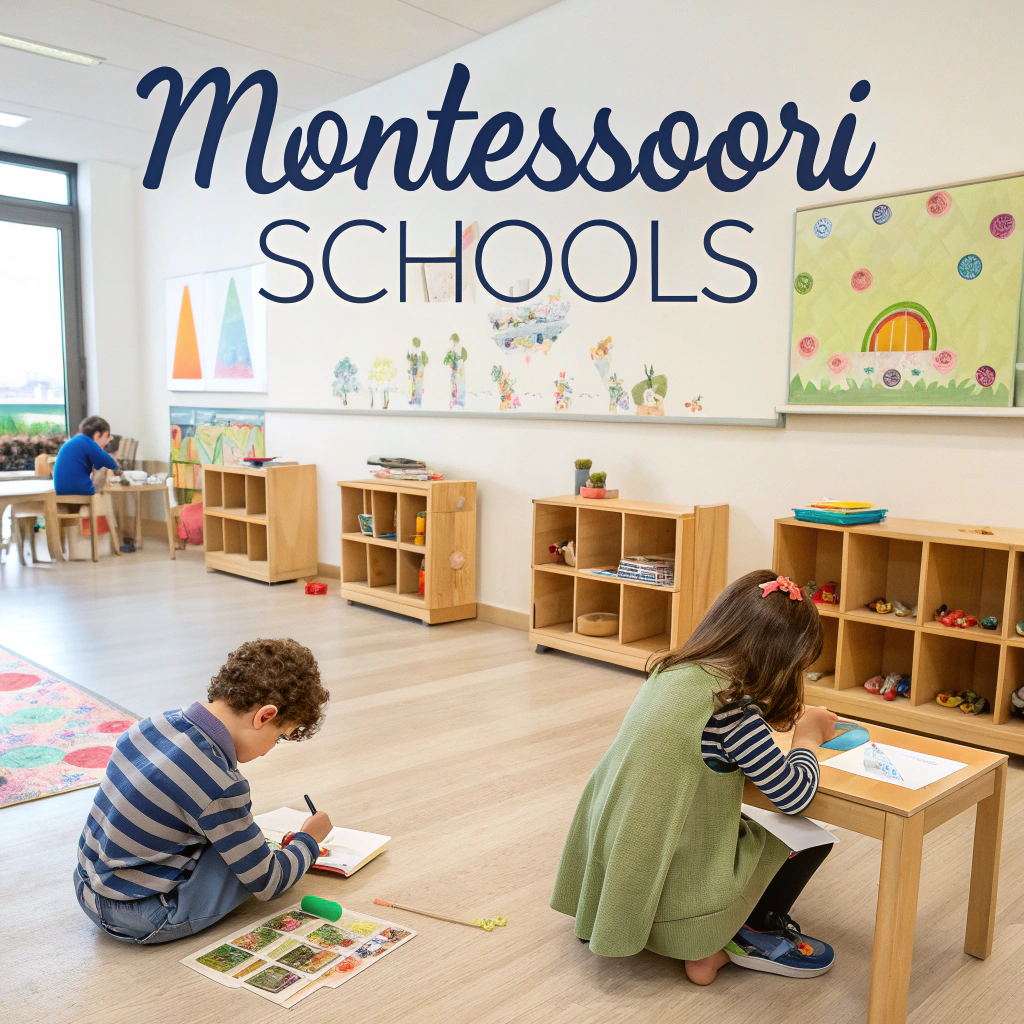
Montessori classroom is referred to as a “prepared environment”, because it is set up in a way that supports independent learning. Child’s eye level shelves are set up, materials are arranged according to difficulty and children are free to select activities that interest them.
This milieu stimulates children to learn language and mathematics at their own speed. Besides this, it enables teachers to monitor and guide rather than push progress.
The model has been a source of inspiration to a great number of early learning centers among which are several Play Schools in Adambakkam where children not only get to interact with well-structured classrooms and purposeful materials but also are able to develop early literacy and numeracy skills with more interest and motivation.
5. Importance of Observation and Individualized Teaching
Unlike customary educational systems in which students are treated uniformly, the Montessori educators observe and assess each child’s performance and cognitive level and only then do they decide to introduce new language or mathematical concepts. This avoids stress, annoyance, and the feeling of making comparisons.
Individualized instruction implies:
- Great in math a kid is able to make a quick progression.
- One who gets less time to understand is given the freedom to discover.
- A child having good language skills can study on his own and move up.
This adaptability is one of the factors that have brought Montessori education fame all over the globe.
- Life Skills, Confidence, and Expression
Moreover, Montessori schools practice the skill which is beyond academics. The kids learn how to accurately present their views, solve problems with logic, follow instructions having multi-step, and cooperate with friends. All these experiences strengthen both language and mathematical abilities.
Once children move to primary school, they already have a solid grip on vocabulary, phonics, reading readiness, number understanding, and logical thinking.
- Why Parents Prefer Montessori for Early Language and Math Development
Parents decide to send children to Montessori settings mainly because they wish their young ones acquiring not only academic skills but also becoming independent thinkers.
Here is a list of things that Montessori classrooms instill in children:
- Reading becomes a pleasure and children love exploring words.
- Instead of memorizing, children understand math.
- Kids become confident when it comes to solving problems.
- Children develop patience, focus, and curiosity.
- Each child learns at his own pace.
For families who are considering the options like playing schools in Velachery or Play Schools in Adambakkam, the Montessori method can be a valuable, reliable base for the success of the early learning period.