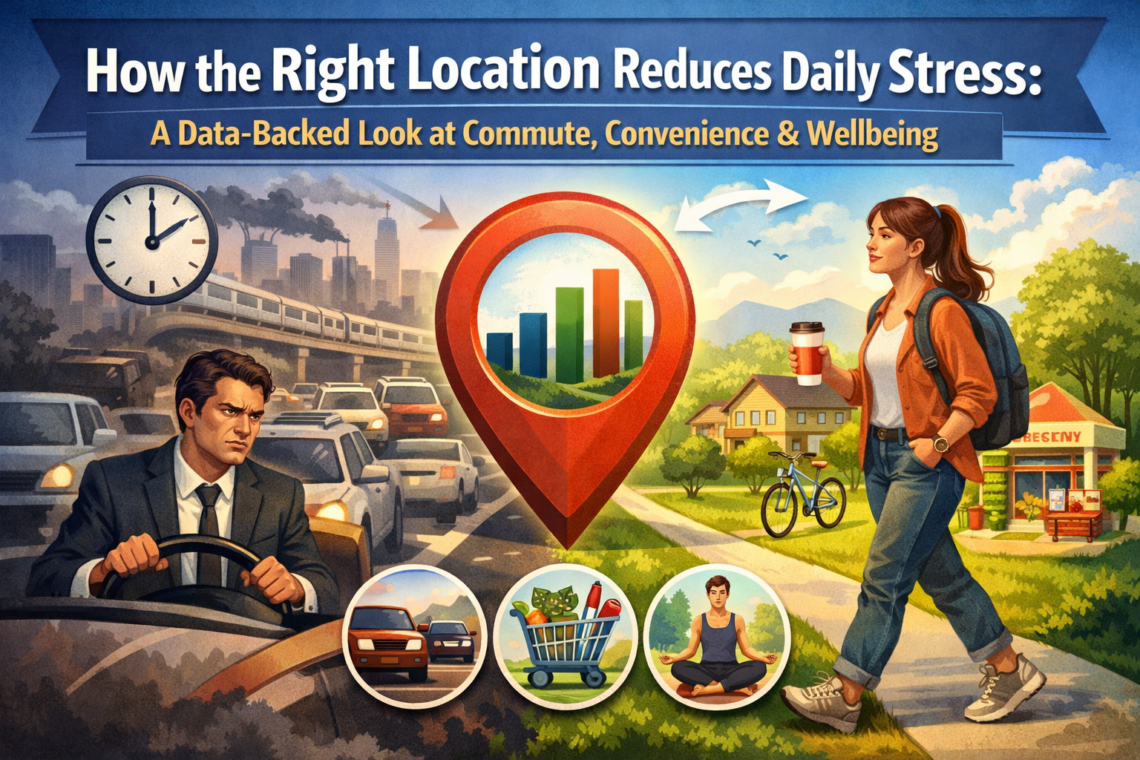
What is Strategic Location in Modern Real Estate?
In contemporary urban planning, a strategic location is defined by “functional distance” rather than simple geographical coordinates. It is the calculated proximity of a residential unit to an individual’s primary activity nodes: workplaces, schools, healthcare, and retail. For a homebuyer, a strategic location is one that minimizes the friction of movement. It ensures that the transition between work, rest, and social life is predictable. A well-placed home reduces the cognitive load of planning daily logistics, allowing the brain to remain in a state of rest rather than constant navigation.
Why Location Matters for Your Biological Wellbeing
Long-range commuting is a documented “stressor” that triggers a sustained sympathetic nervous system response. When you are stuck in traffic, your body remains in a state of low-grade “fight or flight,” elevating heart rates and blood pressure. Over years, this leads to chronic burnout. Choosing a home like an apartment in Sarjapur Road, Bangalore, is a health-conscious decision. By reducing the physical distance of the daily commute, you are effectively lowering your baseline stress levels and protecting your long-term cardiovascular health.
The Hidden Cost: Time Poverty vs. Quality of Life
Time is the only non-renewable resource in real estate. “Time Poverty” occurs when the logistics of your location swallow your discretionary hours.
-
Commute Decay: Every 20 minutes added to a commute has the same negative effect on life satisfaction as a significant pay cut.
-
The Manyata Factor: Living in apartments near Manyata Tech Park allows professionals to bypass the city’s most congested corridors. This creates a “time surplus” that can be reinvested into sleep, exercise, or family.
-
Acoustic Stress: Strategic locations often include a buffer from industrial noise, which is critical for maintaining deep sleep cycles and mental clarity.
Convenience and the 15-Minute Neighborhood
The “15-Minute City” is an urban planning movement aimed at ensuring all essential human needs are reachable within a short walk or cycle.
-
Work-Life Integration: Strategic hubs are designed to keep professional ecosystems and residential blocks in close orbit.
-
Educational Proximity: Reducing the school-bus run from 90 minutes to 15 minutes improves a child’s cognitive performance and a parent’s morning stress levels.
-
Retail Access: When groceries and pharmacies are integrated into the community, the “mental load” of household management decreases.
Practical Application: The Pre-Purchase Reality Check
Before finalizing a property, move beyond the brochure and conduct a physical audit of the environment:
-
Peak-Hour Simulation: Drive from the potential site to your office at 8:30 AM on a Tuesday. Digital maps often underestimate the “stop-and-go” fatigue of specific junctions.
-
Infrastructure Mapping: Identify the proximity to the nearest Metro station or upcoming peripheral ring roads. Connectivity today is a convenience; connectivity tomorrow is an asset.
-
The Walkability Score: Check for “active edges.” A location that allows you to walk to a park or a café without crossing a six-lane highway provides a significant boost to daily happiness.
What’s Next: Moving Toward a Balanced Lifestyle
If you are currently evaluating properties, prioritize your “Commute-to-Square-Footage” ratio. A larger house in a remote location often yields less psychological satisfaction than a well-designed home in a central hub. Start by mapping your most frequent weekly destinations. Focus your search within a 5-kilometer radius of these points to ensure your next home supports your health. Evaluate developers based on their track record of choosing locations with high growth and infrastructure potential.
Conclusion: Your Address is Your Lifestyle
The real estate market is shifting from selling “structures” to selling “wellness.” Developers like Bricks & Milestones recognize that the modern homebuyer is exhausted by urban friction. By focusing on strategic locations and planned infrastructure, they provide a framework for a more sustainable, low-stress lifestyle. Investing in a well-located home is a commitment to your future self. It is the decision to stop spending your life in a car and start spending it in your community. Choose a location that respects your time: it is the most valuable luxury you will ever own.