
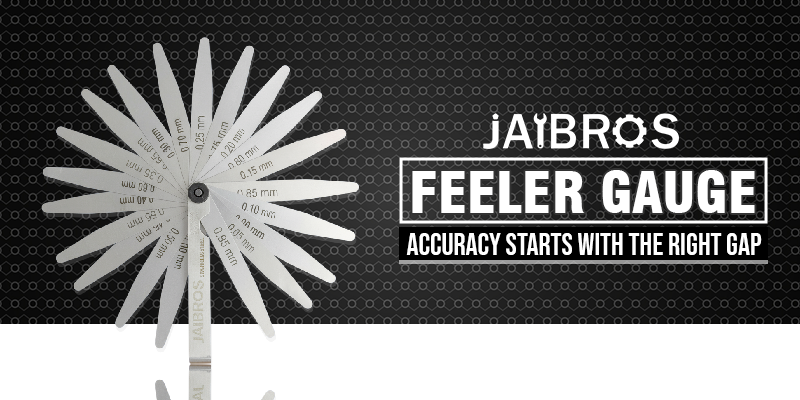
Learn why a feeler gauge is essential in mechanical maintenance, its uses, benefits, least count importance, and real-world applications.
How Feeler Gauge Helps Maintain Proper Clearance in Machines
In mechanical maintenance, accuracy is not optional—it is essential for safety, performance, and extended equipment life. Small clearances between parts can make a big difference in how machines operate. This is where a feeler gauge plays a critical role. Though simple in appearance, this tool helps technicians maintain correct gaps, prevent wear, and ensure smooth operation across many mechanical systems.
Understanding the Role of Clearance in Mechanical Systems
Every mechanical assembly has moving or mating parts. These parts need a specific gap to function correctly.
- Too little clearance can cause friction, overheating, and damage.
- Too much clearance can lead to noise, vibration, and reduced efficiency.
Using a gauge allows maintenance professionals to measure these gaps accurately and maintain manufacturer-recommended tolerances.
What Is a Feeler Gauge and How It Work
The feeler consists of a set of thin metal strips, each precisely sized and marked for thickness. Inserted between two machine components, the feeler verifies the proper gap or clearance by measuring the strip’s sliding into the space. Proper clearance will also have a slight amount of friction when compared to other tools that require either power, calibration programs, or complex setups; therefore, this tool can be used reliably in more difficult work conditions that may present themselves within the workshop..
Feeler Gauge Use in Routine Mechanical Maintenance
Periodic machine servicing is done using one standard gauge. For example, during maintenance on industrial motors or pumps, a technician will use a feeler to check bearing clearance to ensure proper lubrication and accurate bearing alignment. Also, performing regular valve inspections (a common practice in automotive service) helps ensure valve clearance is maintained, as an incorrect valve gap can reduce engine performance or cause damage. Using a gauge allows the mechanic to make precise adjustments to engine components and avoid potentially expensive future repairs.
Importance of Feeler Gauge Least Count
The feeler gauge least count refers to the smallest thickness the tool can measure. This is crucial in high-precision maintenance work.
For instance, in CNC machines or compressors, tolerances are often measured in fractions of a millimetre. A tool with a finer least count allows technicians to:
- Detect early wear
- Maintain consistent performance
- Reduce unexpected machine downtime
Choosing the correct least count depends on the machine specifications and the level of accuracy required.
Practical Applications Across Industries
Mechanical maintenance is not limited to one sector. This tool is widely used in:
Automotive Industry
Used to check spark plug gaps, valve clearances, and brake component spacing.
Manufacturing Plants
Helps in alignment checks, slideway clearance inspection, and preventive maintenance routines.
Power and Heavy Equipment
Ensures proper spacing in turbines, generators, and heavy-duty engines where precision is critical to safety.
Because of its versatility, a feeler is often one of the first tools technicians reach for during inspections.
Benefits of Using a Feeler Gauge in Maintenance Work
Regular use of this tool offers several long-term advantages:
- Improved machine life by preventing excessive wear
- Consistent performance through accurate clearance control
- Cost savings by reducing breakdowns and emergency repairs
- Ease of use, even for field technicians
Many workshops also consider factors such as durability and Feeler Gauge Price when selecting a set, ensuring a balance between quality and budget.
Real-World Maintenance Example
Recurrent Frequent downtime for machinery in Small Manufacturing companies due to Bearing Failures was a Problem. Upon investigation by technical staff, they discovered that improper assembly procedure (clearances) was at fault for the repeated breakdowns. By including regular feeler-gauge checks as part of the Maintenance Program, the ownership was able to develop a “Best Practice” in regards to the Assembly of Equipment. As a result Machine Reliability has improved dramatically, and Downtime has been Reduced dramatically. The above example of how to fix a mechanical problem using a simple tool feeler demonstrates the Effectiveness of using an appropriate tool to Resolve Mechanical Issues that arise on a Regular Basis.
Best Practices for Accurate Measurement
To get reliable results:
- Clean the surfaces before measuring
- Avoid bending the strips
- Use light pressure, not force
- Store the tool properly to prevent corrosion
Following these steps ensures consistent readings and trustworthy maintenance outcomes.
Conclusion
Mechanical maintenance depends on accuracy, experience, and the right tools. A feeler gauge may look basic, but its role in maintaining correct clearances is vital across industries. By helping technicians measure gaps precisely, it supports safe operation, improves performance, and extends machine life. For any maintenance professional focused on reliability and precision, this tool remains essential.
Jaibros is known in the industrial tooling segment for supplying quality mechanical and measuring solutions that support precision maintenance practices. By focusing on accuracy, durability, and practical application needs, Jaibros helps maintenance professionals and workshops achieve dependable and efficient machine operation.
FAQs
Q1.What is a feeler gauge used for?
It is used to measure small gaps or clearances between mechanical parts.
Q2.Where is a feeler gauge commonly used?
It is used in automotive, industrial machinery, and mechanical maintenance work.
Q3.Why is clearance measurement important?
Correct clearance prevents wear, overheating, and machine damage.
Q4.What does least count mean in a feeler gauge?
It means the smallest thickness the tool can measure accurately.
Q5.Is a feeler gauge easy to use?
Yes, it is simple to use and suitable for beginners and professionals.
.