
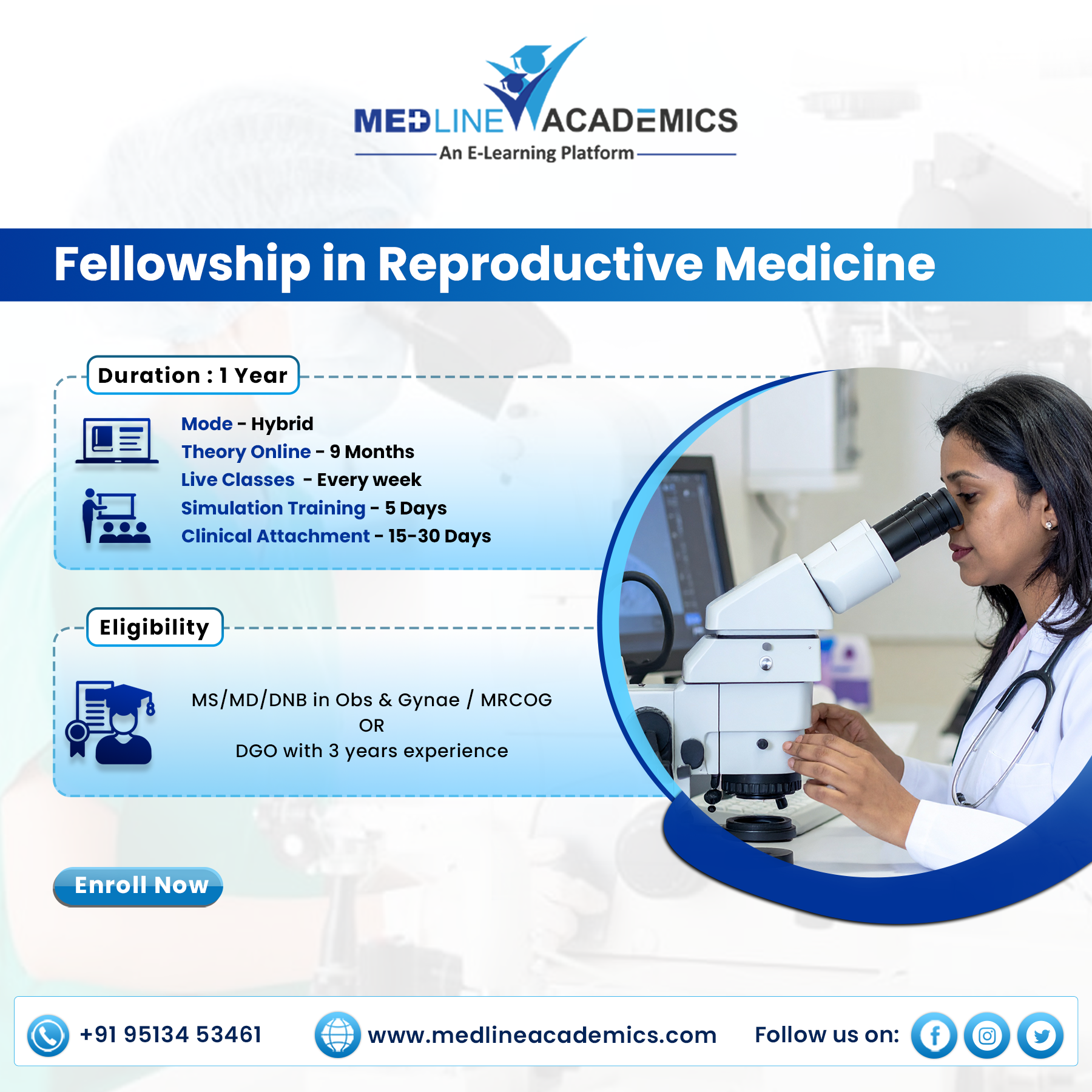
In India, the reproductive medicine has changed remarkably within the last twenty years. As the infertility rates have been increasing, more people have become enlightened, and with the latest inventions and developments in the assisted reproductive technologies (ART), the need to have highly qualified fertility specialists has increased exponentially. Currently, the young doctors who hope to major in infertility treatment would prefer to be involved in structured, practical programs where they can receive real-time clinical exposure, research, and mentorship. It is here that a Fellowship in Reproductive Medicine is not only an educational achievement, but also one that is a chance to open the gateway to a career.
Indian training in reproductive medicine was not consistent over many years. Majority of clinicians were taught in small, piecemeal workshops or in short-term observership. But nowadays, reproductive medicine will require much more, accuracy in diagnosis, control over IVF, clinical decisions based on evidence, and understanding of the patient, compassion. It is in light of this requirement that the leading medical schools and fertility centres today provide full-fellowship training programs that would bridge the divide between theory and assured clinical practice.
The Importance of a Fellowship in Reproductive Medicine in the Present day.
A properly structured Fellowship in Reproductive Medicine opens the doors that are usually closed by the traditional post-graduate qualifications. Reproductive sciences are a combination of endocrinology, embryology, andrology, ultrasound, and highly sophisticated ART methods. Proficiency is difficult to achieve without a structured training.
This is why this fellowship has become necessary:
Increasing Demand of fertility specialists in India.
In India, the researches indicate that almost 15-17 percent of couples experience problems related to infertility. The growth of IVF centers in metropolitan and tier-II urban centers has left an immense demand of skilled professionals who are able to handle various infertility cases with precision and sensitivity.
Practical experience in Assisted Reproductive Methods.
A fellowship provides doctors with practical experience in unlike short courses:
- Monitoring and ovulation stimulation.
- IUI & IVF cycles
- Embryo transfer and oocyte retrieval.
- Stimulation protocols
- Ovarian reserve assessment
- Managing complicated infertility cases.
- It is this field experience that produces a confident fertility specialist.
- Clinical Learning across Disciplines.
Multi-dimensional fertility care multi-dimensional fertility care has taken the shape of endocrinology, reproductive genetics, minimally invasive surgery, radiology and embryology. Fellows are taught to treat patients in a holistic manner so that to enhance patient care and trust.
Academic Development and Research.
Best fellowship programs promote active involvement in scholarly research, case presentations, national meetings and publications which will be the necessary background to the individuals who aspire to establish great scholarly careers or become thought leaders.
How to select the Best Infertility Course in India: Selecting the Right One.
As more and more choices are available, young clinicians often pose the question: What should the online infertility courses in india be compared with the rest?
The following are the main components of a good program:
- Structured Curriculum
- There should be a comprehensive curriculum that includes:
- Reproductive endocrinology and physiology.
- Diagnostic imaging
- Stimulation protocols
- Embryology lab practices
- ART procedures
- High-risk case management
- Reproductive counseling and ethics.
University-sponsored, or other medical council, or academic programs tend to have better organization and responsibility.
Hard Skills Training as opposed to Theory.
The most ideal infertility program in India does not focus on observing operations through the window. Fellows have to be engaged in clinical decision-making, processes, and counselling of patients.
Nurturing with top leaders in the field of fertility.
Training with renowned pioneers in the field of reproductive medicine helps improve clinical judgment and fine surgical skills. Mentor guidance can assist the fellows to become more self-confident and self-sufficient in their thinking.
Availability of a properly-filled IVF Lab.
When exposed to a state-of-the-art IVF lab, fellows can be able to comprehend:
- Embryo grading
- Culture conditions
- Cryopreservation techniques
- Quality control and workflow in the lab.
- The embryology element is essential to the competence in general.
- Opportunities for Research
Academic credibility and national and international recognition are the benefits of research involvement.
- Placements and Career Support.
- Best institutions provide fellows with:
- Setting up IVF centres
- Merging with reputed fertility hospitals.
- Becoming consultants
- Giving academic lectures.
- Building clinical practice
Career mentoring can be a key determinant in the professional path.
The city of Bangalore has been revealed as one of the most popular centres of reproductive medicine in India due to its developed medical facilities, qualified clinicians and a culture of research and innovation. The city is also preferred by many young doctors who are seeking fertility training due to the presence of reputed centres in the city through which they get exposure on a world-class scale.
An ideal IVF hospital in Bangalore would normally provide:
High Clinical Volume
Having a busy fertility centre helps fellows to be exposed to a broad range of infertility cases – such as easy ovulatory disorders to complicated IVF failures, endometriosis, and male infertility and old age reproductive issues.
- Modern ART Technologies
- Such innovations that are employed in these hospitals include:
- ERA (Endometrial Receptivity Analysis)
- Embryo monitoring systems of time lapse.
- AI-driven embryo selection
- High level genetic screening (PGT).
- Sub-zero storage with enhanced quality control.
Such training environment through fellowship enables the clinicians to be ready to handle future demands without fear.
Academic Faculty in all Areas.
The IVF hospital in Bangalore is the most advanced, and it unites the most prominent specialists in the fields of gynaecology, embryology, reproductive genetics, fetal medicine, and minimally invasive surgery-guarantees an interdisciplinary education.
Ethical, Patient-Centric Practice.
The IVF centres with quality focus on patient counselling, transparency and ethical decision making- qualities that are fundamental in creating long term professional credibility.
Why Bangalore is a Destination of Fellows in the whole of India.
The reasons why Bangalore is the choice of training destinations are:
- Academic Reputation
Nationally and internationally recognised fellowships are provided by reputed institutions.
- Technological Maturity
The healthcare ecosystem in the city is well developed, thus suitable in developing ART skills.
- Training Under Nationally Distinct Faculty.
Future fertility experts have the opportunity to study under the pioneers that have defined the reproductive medicine in India.
- Strong Career Opportunities.
After training, many fellows are given an opportunity to work in the most prominent IVF centres, build their own units or become part of an academic institution.
The benefits of a Fellowship in Reproductive Medicine on Your Career.
A fellowship will be a value addition:
Enhanced Patient Success: Fellows have mastered ART procedures and this has led to a better success rate of patients.
Greater Patient Trust: When specialists are well trained, they will establish a good reputation within a short period.
Career Mobility: Career opportunities become open in the hospitals, academic institutions and in the private practice.
Entrepreneurial Development: A significant number of fellows develop their own IVF centers or fertility clinics without any doubts.
Academic Recognition: Conference presentations and research publications create long-term credibility.
A fellowship is an indication of skills in an ever-changing profession.
How to become a fertility specialist: Conclusion.
Fellowship in ART and Reproductive Medicine is the most useful of the qualifications which a clinician can strive to achieve in gaining a career based on infertility management. As the demand for fertility care services spreads all over the world, the number of trained professionals of reproductive medicine in India is increasing.
Having selected the optimal infertility course in India – preferably one that would be linked with the optimum IVF hospital in Bangalore – structured learning, practical experience, mentorship, and long-term career advancement would be ensured. With superior clinical exposure and ethical and patient-centric training, fellows can become capable fertility specialists who can change the lives of many.
The moment is now, in case you are looking to make the next step in your career. An effective fellowship will not just enhance your knowledge; but, it will make you the pioneer of the reproductive healthcare in India.