
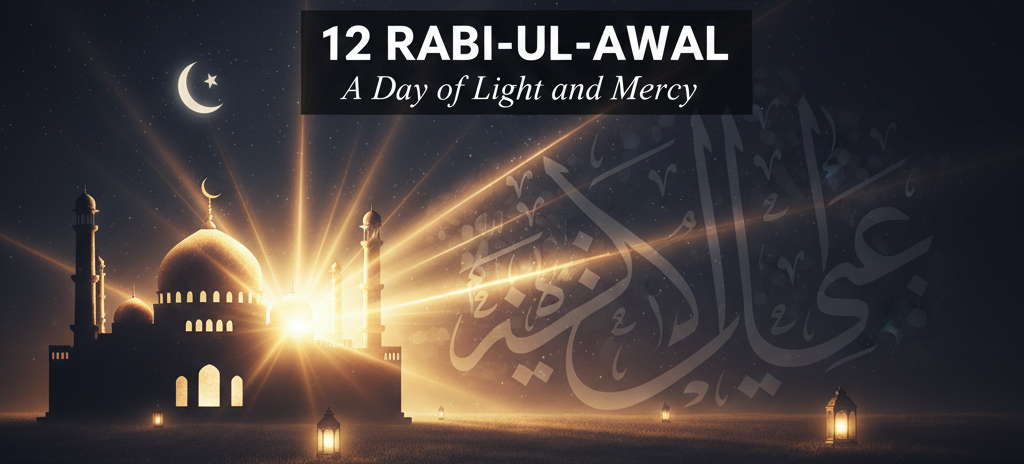
In Islam, 12 Rabi-ul-Awal holds immense significance because of its association with the birth of the last messenger of Islam, the Great Holy Prophet Muhammad (PBUH). Across the world, the Muslim community celebrates this day as Eid al-Milad ul Nabi, as a great event. This day comes in the Islamic month of Rabi-ul-Awal. According to the Islamic Lunar calendar, Rabi-ul-Awal is the third month that comes after the month of Safar. Like Ramadan and Zilhajj, this holy month has great importance as it is tied to the life of the Holy Prophet Muhammad (PBUH ).Beyond the birthday, many other significant events of the Prophet(PBUH )’s life occur in this month, such as some important historical happenings, migration, and death. That’s why this month is especially associated with him, honoring his character, life, and devotion to Allah (SWT).
Due to the great importance of the 12 Rabi ul Awal date, every Muslim must be aware of the significance of this day to strengthen their religious roots. In this blog, we will shed light on why 12th Rabi-ul-Awal is important and its spiritual and moral impacts. Read on for details!
Why the 12 Rabi-ul-Awal Date is Important?
According to Islamic sources, on 12 Rabi-ul-Awal, the Prophet (PBUH) was born in the city of Mecca in the year 570 CE or 571 CE. His birth is considered an imperative event in Islamic history, as he is the last Prophet who was sent by Allah (SWT) to deliver the message of Islam to teach the highlights of humanity, compassion, justice, equality, and moral integrity. This is the reason the 12 Rabi-ul Awal date is celebrated as Eid Milad-un-Nabi in honor and devotion to the Prophet (PBUH).
Therefore, being a Muslim, every believer must practice his Sunnah and study his Seerah and ensure to incorporate his examples and imitate his character, devotion to Islam. Moreover, believers should dedicate more time to performing kindness and worship to strengthen their faith in Islam by walking through the merciful Prophet’s (PBUH) footsteps.
When is 12 Rabi-ul-Awal 2025?
In 2025, 12 Rabi ul Awal is celebrated by the Muslim community as an Eid-Milad-un-Nabi on Saturday, September 6, 2025, across the globe. The date was based on the sighting of the moon for the month of Rabi ul Awal. It was also an Eid Milad ul Nabi 2025 public holiday in countries like Pakistan.
When is Rabi-ul-Awal expected in 2026?
According to the Islamic lunar calendar, in the next year, in 2026, the month of Rabi-ul-Awal is expected to start on 14th August and end on 11th September; however, it will vary depending on the sighting of the moon.
As the Islamic calendar is observed on the basis of the lunar cycle, these dates are subject to moon sighting. They can vary slightly because the month starts at different times of the Gregorian calendar. We recommend that you check with your local mosque closer to the time.
Key Note
This estimation takes into consideration the annual change of the date in the Gregorian calendar since the Islamic lunar calendar year is 11 to 12 days shorter than the solar year.
How do Muslims celebrate 12 Rabi-ul-Awal?
Muslims celebrate 12th Rabi-ul-Awal, also known as Eid Milad-un-Nabi, by commemorating the birth of the Great Holy Prophet (PBUH) with different events focused on his character, life, and teachings. On this day, the extent and attributes of celebrations vary based on Islamic customs and different cultures, with some opting for more subdued observances and others organizing detailed events to honor and celebrate the life of the Prophet Muhammad (PBUH).
According to a source, it is reported that the Prophet (PBUH) also emphasized making his birthday a day of worship. And when he was asked about fasting on Mondays, he replied:
“That is the day on which I was born and the day on which I was entrusted with the Mission, or when I was first given Revelation”.[Hadith | Muslim]
However, across many sects, including the four Sunni schools of law, Shia Muslims, and some scholars, it is generally accepted to celebrate the holy day. Celebrations often entail private and public gatherings with special feasts and prayers, as well as decorating mosques and homes. Also, the Eid al-Milad un Nabi day is celebrated through reciting the Qur’an and poetry in his praise, and performing merciful acts like him, such as helping needy people and giving them funds and donations, as the Sunnah of the Great Prophet Muhammad (PBUH).
Here are just some ways Muslims around the world mark the day:
- Reciting the Quran & religious poetry in praise of the Prophet’s (PBUH) character while also worshipping Allah through dhikr.
- By preaching and talking on the Seerah, or the life of the Prophet (PBUH), remember his role as a mercy to humankind.
- In some countries, children perform parades while reciting nasheeds in praise of the Prophet Muhammad (PBUH).
- Performing the act of mercy through donations, funds, and charity to needy people.
- Distributing food among the orphans and the poor or less fortunate community.
The Benefits of Giving Donations During the Rabi-ul-Awal
Acts of worship and kindness are not only about praying and paying forward good deeds to the community, but they’re also about giving to those who are less fortunate. The 12 Rabi-ul-Awal date is a special day in Islam, so it is better to help those who are in need. So, giving funds and donations were very close to Muhammad’s (PBUH) heart as he treated everyone with respect and helped those in need. This wasn’t just because charity in Islam is important and makes up one of the five pillars (Zakat), but also because of the kind and caring soul he was.
Hadith Reference
According to a report, the Holy Prophet ﷺ said: “The upper hand is better than the lower hand. … The upper hand is that of the giver and the lower (hand) is that of the beggar.”
[Sahih al-Bukhari 1435]
Hence, doing good deeds, such as donating to those less fortunate, allows Muslims to take on the Prophet’s (PBUH) spirit and also earn rewards from Allah (SWT). On top of this, these types of giving reflect the true meaning of Rabi-ul-Awal. This month translates to “the first spring” and is the beginning of the spring season for Muslims. It’s just the same as the third month in the Gregorian calendar, which starts the physical season of spring. Spring is a time for rejuvenation and transformation, and this is no different in the Islamic calendar.
Be a part of This Merciful Journey with Sundus Foundation- A hope for those who are in NEED
Hence, the 12 Rabi-ul-Awal date focuses on spiritual growth and reflection. So, the act of donating funds in Islam holds great significance, and Rabi al-Awal is the perfect time to be generous. So, by giving charity on this day, you can explore the virtual rewards and please Allah (SWT). Moreover, your generosity has the power to change lives, and even the smallest contribution can bring hope, relief, and dignity to those struggling the most.
So what stops you now? Extend a helping hand and become the reason for someone’s smiles. Stand with the Sundus Foundation to participate in this kind act. Together, we can create a lasting impact—one donation at a time.
FAQS
Why do Muslims ask “when is 12 Rabi ul Awwal”?
As it commemorates the Prophet’s birth and his passing, therefore, it is a day of remembrance, reflection, and devotion for him.
Do all Muslims celebrate 12 Rabi-ul-Awal in the same way?
No, cultural practices vary; however, the proper way is for the celebration to avoid religious violations, such as gathering for dhikr together and excessive indulgence in food and sweets.
How can we determine the date of 12 Rabi ul Awal in advance?
By following the Islamic lunar calendar and announcements from local Islamic authorities, we can determine the 12 Rabi ul Awal date.
What are the virtues of Rabi ul Awal?
Although the virtues of this month are many as it is dedicated to celebrating the Prophet Muhammad’s (PBUH) birth and reflecting on his legacy. One of the main virtues of Rabi-ul-Awal is the chance to perform acts of giving charity to needy people in Islam.